Meet Bella: A new way to teach children how AI works
IchiZero launches Bella, an AI learning companion helping children understand, explore and shape the technology that is changing their world.
IchiZero launches Bella, an AI learning companion helping children understand, explore and shape the technology that is changing their world.
Artificial intelligence is rapidly becoming part of everyday life. Yet for many children, AI remains something mysterious that happens behind a screen — something they use rather than something they understand.
Children growing up today will live and work alongside increasingly intelligent systems. They will need to know not only how to use AI, but how to question it, understand its limitations, recognise its risks and participate in shaping what comes next.
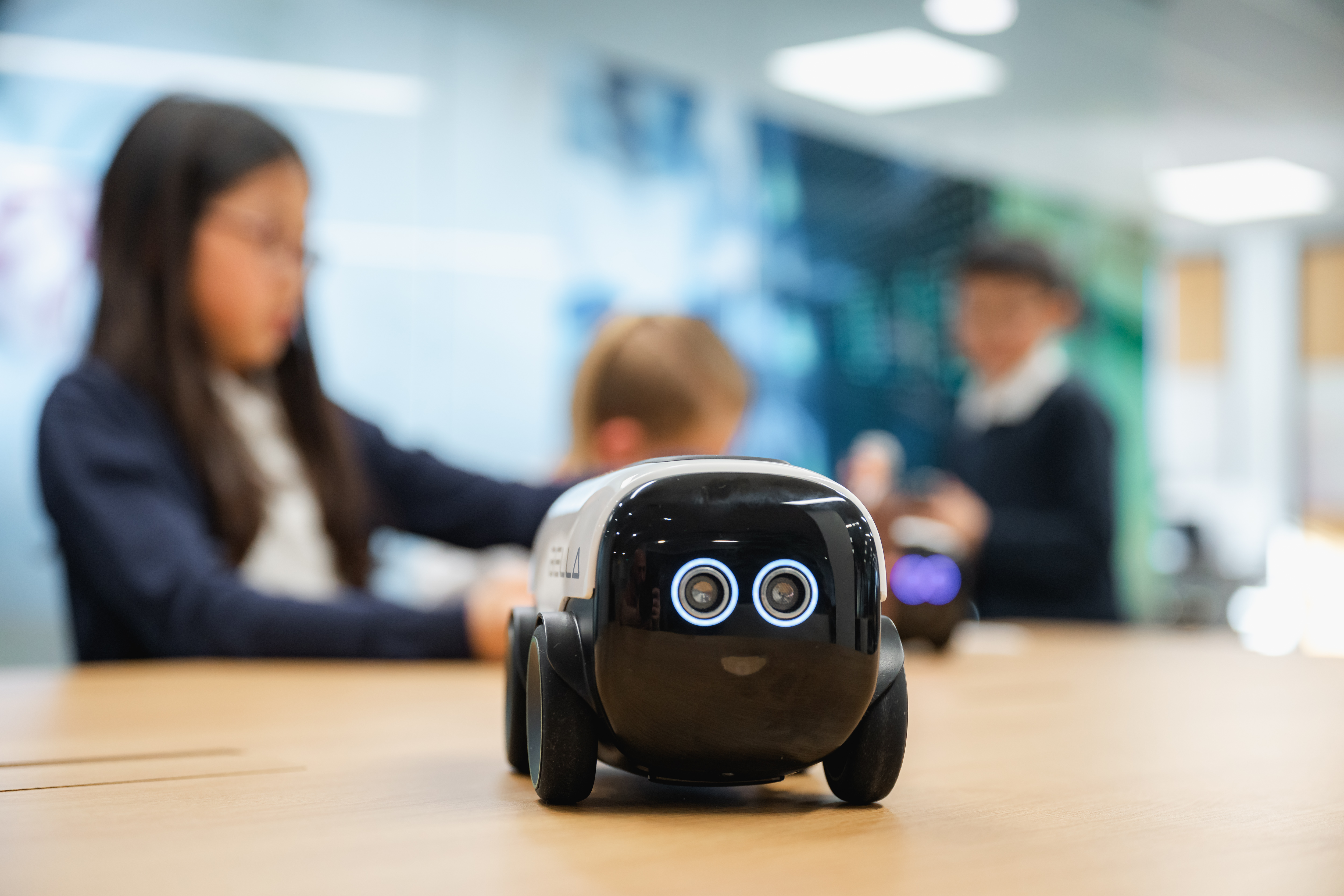
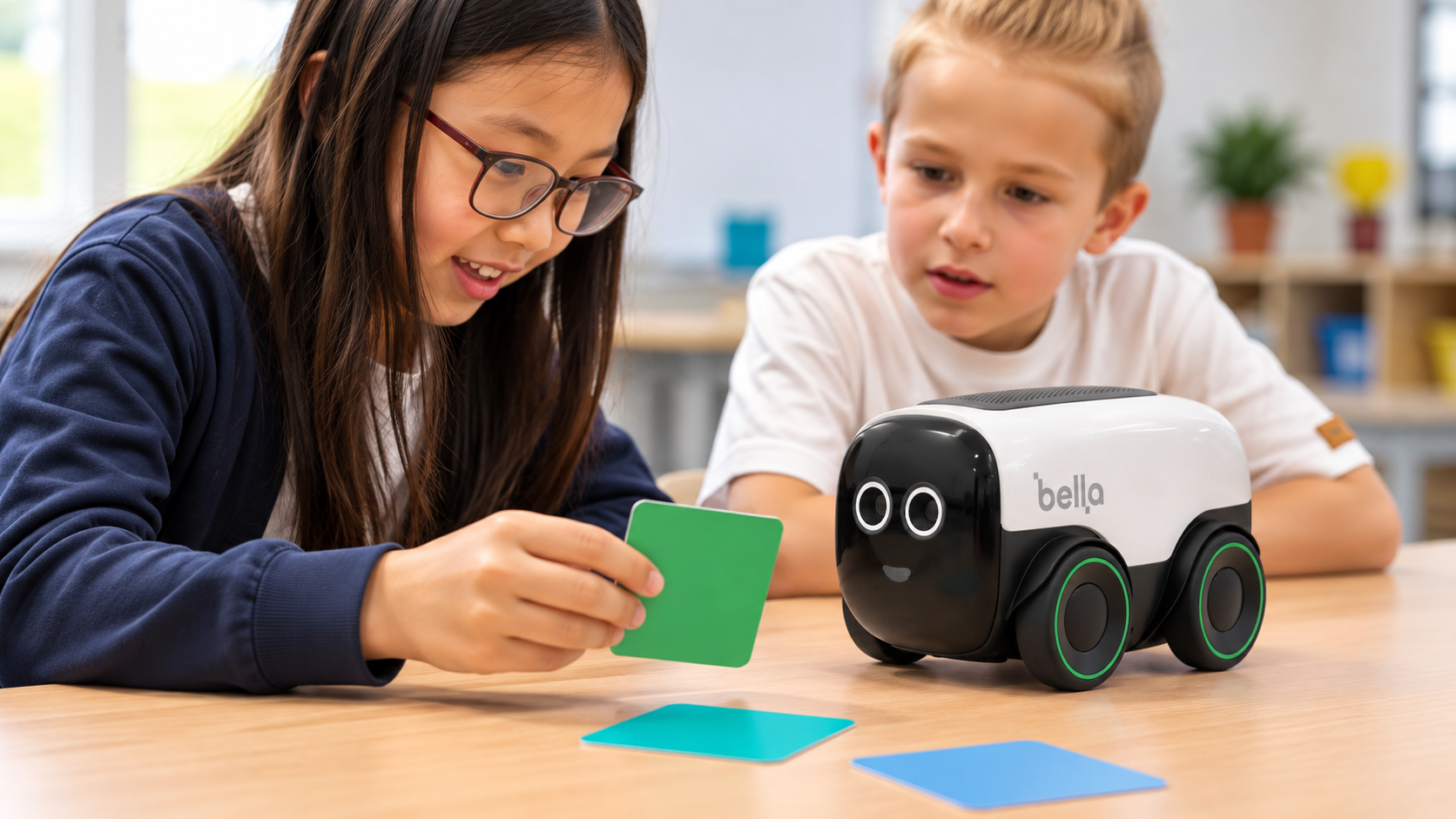
Bella is a physical AI learning companion designed to make AI tangible, playful and accessible for children aged 6–12.
Through hands-on interaction, a browser-based learning environment and ready-made lessons, children can explore how machines sense the world, learn from information, make decisions and sometimes get things wrong.
Instead of simply being told what AI is, children can see it, touch it, experiment with it and question it for themselves.
No coding experience required. No need to be an AI expert. Just curiosity.
In 2024, a small group of researchers, designers, engineers and educators at Nokia Bell Labs in Cambridge found themselves asking a simple question:
After 100 years of shaping technology, who gets to shape what comes next?
Many of us were parents. All of us were tinkerers. In the evenings, after work and after bedtime, we started building things for our own children. We wanted playful ways to explain how AI works, how machines “listen” and “learn”, and why intelligence should be questioned rather than mystified.
We wanted something tangible, safe and joyful. Something that could live in any classroom. Something children could touch, experiment with and learn from rather than simply watch on a screen or interact with through a line of code. That exploration became Bella.
The AI divide does not begin in adulthood. It begins in childhood.
Closing that divide does not necessarily require more complexity. It requires better design, deeper empathy, practical experimentation and the courage to start early.
Bella is now being brought to life by IchiZero Oy, a Finnish company founded to make AI education accessible to children everywhere.
Bella combines a physical learning companion with a browser-based platform and ready-made educational content. Children can experiment with Bella’s ability to see, hear and respond to the world around it, while learning fundamental concepts behind AI and intelligent systems.
The ambition is bigger than a robot.
IchiZero is building an AI learning platform and ecosystem that brings together physical interaction, curriculum, digital learning and a growing community of educators and creators. The mission is to give children and educators practical ways to develop AI literacy regardless of geography, language or infrastructure.
This autumn, Bella will take its first major step into Finnish classrooms.
IchiZero is partnering with Nokia, Elisa and Foundation PS on a collaboration designed to give pupils a concrete, age-appropriate way to understand what AI is, how it works and how it affects the world around them.
The programme is being implemented together with NYT Yrityskylä and IchiZero Oy, and is planned to launch across four centres in Finland from September 2026, reaching approximately 19,000 children during the first phase.
For IchiZero, this is more than a pilot.
It is the beginning of a long-term mission to make AI literacy something children can experience, question and build upon from an early age.
“Co-creation across technology, education and research is essential to ensure that AI is used safely and for the benefit of society. This program shows how AI can be introduced in schools in a structured and responsible way and is a clear example of Nokia’s approach to bridging the digital divide, in this instance through digital skill building,” says Esa Niinimäki, Chief Legal and Administrative Officer at Nokia.
“Children and young people and their digital skills have been at the core of Elisa’s sustainability work for over a decade. Artificial intelligence is already shaping society and will also play a major role in future working life. We see this collaboration as an important first step in bringing practical tools to schools and helping children understand and use AI safely and responsibly,” says Kati Nyman, Executive Vice President, Corporate Chief of Staff at Elisa.
“Foundation PS is on a mission to build a strong AI ecosystem and long-term research excellence for Finland’s and Europe’s competitiveness and growth. This collaboration is an important step in ensuring essential AI understanding is taught to Finnish students at a young age, building their curiosity and digital skills. Foundation PS is excited to support this initiative and further research into the topic,” says Peter Sarlin, Founder & Chairman of Foundation PS.
Bella is still evolving, and the children and educators who use her will help shape what she becomes. She begins in classrooms, with broader access planned over time.
Join the list to hear more. Get Connected
Building in AI education, research or policy? We would love to hear from you: info@ichizero.ai
Bella helps children understand AI by letting them teach it. Using curriculum-led Flashcards and Bella Flow, they can collect examples, train simple models and create behaviours — without writing code.
Bella is a small AI learning robot for children aged 6–12. Bella can see, hear, talk, sing, move, and glow. But the real idea is not simply to give children a clever robot. It is to let them teach Bella something new — and learn how AI works in the process.
The journey starts in the Bella App, a browser-based, offline-first and mobile-first application. Inside the app, children can explore structured learning activities called Flashcards. Flashcards are created by teachers and educators in the Bella Education Studio and are designed around classroom learning objectives. One Flashcard might ask a child to teach Bella to recognise an apple. Another might ask children to teach Bella to recognise different sounds and react to them.
Open a Flashcard and the child moves straight into Bella Flow, the no-code visual environment inside the app. Take the apple challenge. The child uses Bella to collect a few pictures of apples, adds simple labels, and then presses Train. That is it. No code, no model configuration, and no machine-learning jargon on screen. The Bella App does the technical work in the background, trains the model and sends it to Bella.
Then the interesting part starts. Does Bella recognise the apple? What about a green one? What if the light changes, or the apple is half hidden? And what happens when Bella gets it wrong? That mistake is not a dead end. It is the lesson. Maybe there were too few training examples. Maybe every apple was red. Maybe the pictures were all taken from the same angle. Children can add better examples, train again and see what changes. The same idea works with sound: record a clap, record a whistle, add labels, train, test, and see whether Bella can tell the difference.
Without ever writing code, children begin to understand what training data is, why labels matter, and why AI can make mistakes.
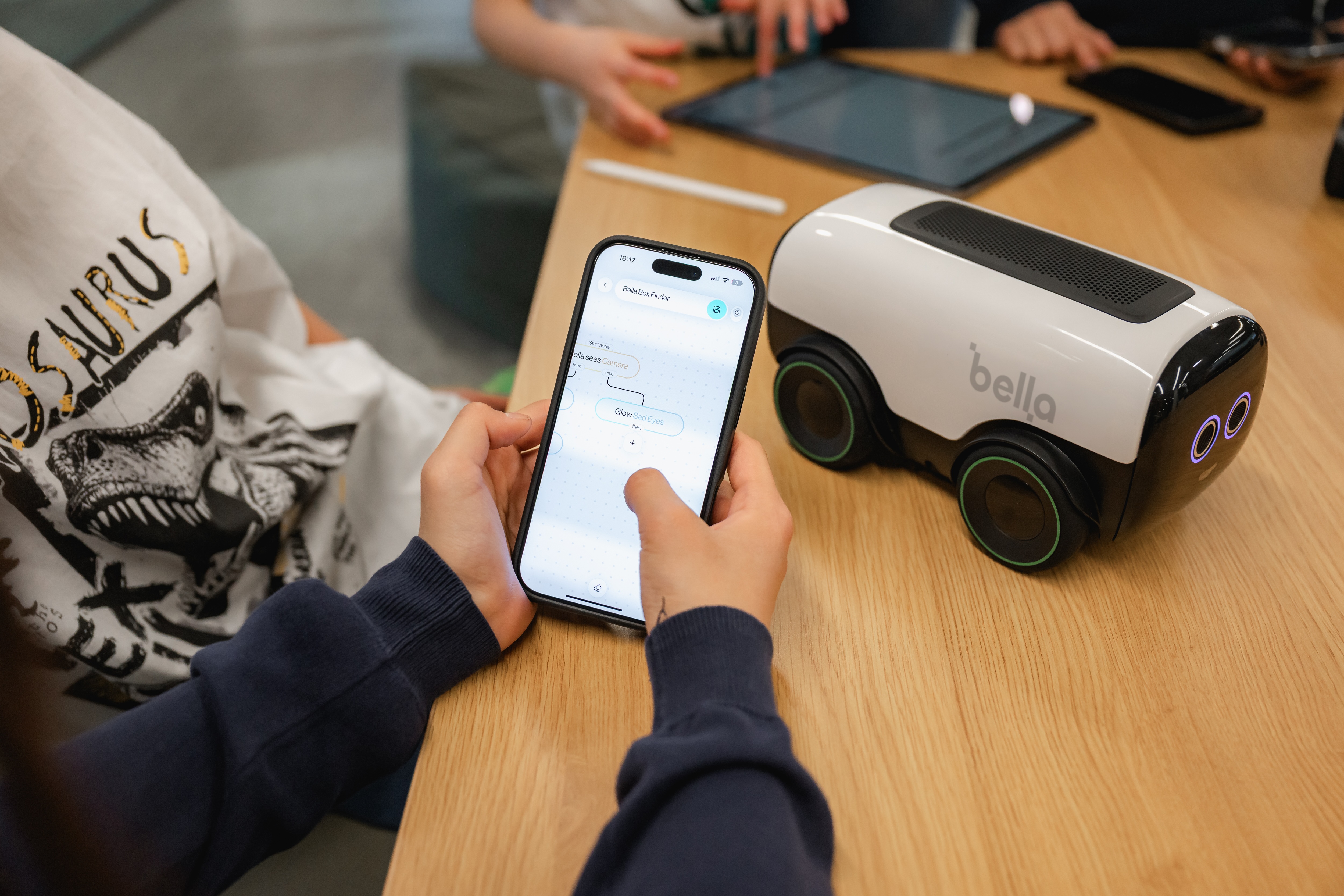
Recognition is only half the fun. Bella Flow also lets children decide what should happen next. If Bella sees an apple, Bella can glow green. If Bella hears a clap, Bella can turn around and play a sound. A recognition can trigger movement, sound, light or a whole sequence of actions.
So a machine-learning model does not stay hidden inside an app. It becomes something physical — something Bella actually does in front of the child.
The learning process is deliberately simple. A child starts with a Flashcard, collects examples with Bella, labels them, trains the model with one tap, tests what Bella has learned, and then creates a response. If Bella gets something wrong, the child can change the examples, train again and immediately see the difference.
The educator creates the activity. The teacher brings it into the lesson. The Bella App provides the tools. Bella Flow makes it possible without code. And Bella brings the result to life.
The goal is not to turn every child into a machine-learning engineer. It is to help children understand something much more important:
AI learns from data. AI can make mistakes. And people shape how AI behaves.
Bella is still evolving, and the children and educators who use her will help shape what she becomes. She begins in classrooms, with broader access planned over time.
Join the list to hear more. Get Connected
Building in AI education, research or policy? We would love to hear from you: info@ichizero.ai
Nokia, Elisa, Foundation PS and IchiZero are joining forces to give thousands of Finnish children a hands-on introduction to artificial intelligence.
This autumn, Bella is going into four Yrityskylä learning centres across Finland, where she'll meet an estimated 19,000 sixth-graders over the course of the year. That's only possible because three organisations decided this was worth building together.
On 27 August, Elisa, Nokia and Foundation PS announced a collaboration to bring AI literacy into Finnish primary schools at national scale; delivered together with Nuorten yrittäjyys ja talous NYT (Yrityskylä) and us. Bella began as a research project at Nokia Bell Labs; we're the Finnish company that grew out of that work and now builds and develops her. The programme combines Bella, a browser-based teacher app, and ready-made lesson materials, and it's built around the same principles we've held from day one: no coding, no screens in pupils' hands, no internet connection required, and lessons aligned with OPH and OKM guidance rather than bolted onto the curriculum as an extra.
Nokia's involvement traces straight back to Bella's origins at Bell Labs. Esa Niinimäki, Nokia's Chief Legal and Administrative Officer, framed the partnership this way: "Co-creation across technology, education and research is essential to ensure that AI is used safely and for the benefit of society. This program exemplifies how AI can be introduced in schools in a structured and responsible way and demonstrates Nokia's approach to bridging the digital divide together with our customers and other partners, in this instance through digital skill building."
Elisa brings its own long-running commitment to young people's digital skills to the table. "Children and young people and their digital skills have been at the core of Elisa's sustainability work for over a decade," said Kati Nyman, Elisa's EVP and Corporate Chief of Staff. "Artificial intelligence has rapidly become a new fundamental skill, with an impact that extends across learning, working life and society as a whole. Through this collaboration, we want to bring practical tools to schools that help children and young people harness the opportunities of AI safely and responsibly."
Foundation PS (Säätiö PS), founded by Peter Sarlin, backs the programme both financially and academically, it's also supporting further research into AI literacy through ELLIS Institute Finland. "Foundation PS is on a mission to build a strong AI ecosystem and long-term research excellence for Finland's and Europe's competitiveness and growth," Sarlin said. "This collaboration is an important step in ensuring essential AI understanding is taught to Finnish students at a young age, building their curiosity and digital skills."
None of this reaches a classroom without Yrityskylä. Kaisa Koistinen put it simply: "We have a truly exciting and interesting autumn ahead of us at Yrityskylä."
We don't take it for granted that three organisations with this much reach chose to build the programme around Bella rather than build their own. It's also the first time we'll be running the same activity across four centres at once, which, as much as it's a rollout, is also our best chance yet to learn something real about how children actually build intuition about machine learning.
If you're a school, a researcher, or an organisation that wants to be part of what comes next, we'd like to hear from you.
Read more:
Elisa Press Release
PS Foundation Press Release
JA Finland (NYT Yirtyskylä)
Nokia Bell Labs